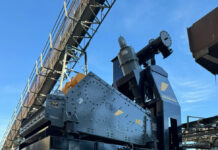

by Dirk Bloemendaal A 40-inch, 150-foot telescopic Superior stacker handled a transfer of 65,000 cubic yards of fill sand across busy highway US-31 just south of Manistee, MI. Manistee is located on the east side of Lake Michigan.  | The best way to move the dirt in accomplishing their goal without disturbing traffic was the use of stack conveyors over the highway. |
|  | Conveyor filling Stacker over US-31. |
|
Team Elmers Excavating Co., of Traverse City. MI, the dirt and utility subcontractor, is working on the project, which is for a new Glen’s Market Chain Store, which is getting started and is expected to be completed later this year (2009). The general contractor for the new market store is Rohde Construction of Kentwood, MI. The site area for the store involved moving an enormous amount of fill sand to fill in a deep valley on the east side of the busy US-31 highway which leads into the City of Manistee. Elmers, with the blessing of MDOT (Michigan Department of Transportation), found that the best way to move the dirt in accomplishing their goal without disturbing traffic was the use of stack conveyors over the highway. Engineered fill for the building location required 130,000 cubic yards of material in which a substantial amount was removed from a nearby existing retention pond area adjacent to the building site. The site involved a 70-foot cut from its original elevation which basically resulted in turning a hill into a valley. The remaining amount of fill (70,000 cubic yards) of fill was moved across the highway and over traffic with the use of stack conveyors. The required minimal clearance for truck traffic and proper signage was 17-feet. A 40-inch x 175-foot telescopic Superior stacker was put into use over the highway. The unit was retrofitted with metal sheets and geotextile fabric to capture any sand that might fall from the conveyor onto car traffic.  | West side of US-31. |
|  | Stacker fills Cat 290 loader. |
|
Elmers equipment setup was as follows. On the west side of the highway Elmers placed a 40-foot long Lippman Feeder J22 x 48 Jaw Crusher without the crusher portion running. The used feeder bin portion of the jaw crusher was used to transfer material to the stack conveyor. To accomplish this, Elmers used two smaller 90-foot x 36-inch hand built conveyor units. From here the material was fed into the Superior telescopic stacker which crosses US-31. Elmers used two model 290 Cat loaders fitted with 5-cubic yard buckets to feed the hoppers. Elmers averaged 5,000-6,000 cubic yards of dirt per day into the conveyors. The operation proved to be an amazing dance of machinery at work on the fill site with some areas covering over 20-foot fill sections.
To handle the fill dirt, Elmers operated two MTS 865 Cat Challenger Tractors which pulled KTES Pans having 24-yard capacities. Also handling the incoming fill sand were two Cat CH95E and one CH75E Cat Challenger Tractors pulling 18-yard Miskin pans. Compaction was done with two Cat CS563 compactors. A final scraper unit equipped with a GPS unit handled the final tune elevation as well as other fill area bringing the grade up to one inch of grade. Elmers additional equipment spread on the project included a Cat D6 dozer, a Case 850 dozer, a Cat 938 loader, a Bobcat unit and a Cat 320 excavator fitted with a 1.5 cubic yard bucket.  | Elmers used two model 290 Cat loaders fitted with 5-cubic yard buckets to feed the hoppers. |
|  | Fill site (foreground) East side of US-31. D6 Cat dozer spreads incoming fill. |
|
In addition to the large land fill, Elmers is placing over 700 lineal feet to 22,000 square feet of retaining wall in three sections. Each wall section will average 8 to 21-feet tall around three sides of the site. The wall is designed to hold the incoming fill in place. Each block being used weighs 82-pounds (2.706 million pounds of block will be set in place). There will be approximately 33,000 blocks in the wall sections when completed. Elmers is also placing storm sewer catch basin sections during the wall installation since the close proximity to the wall and the geogrids required to anchor the wall for support is required. Elmers is using a crew of 10 personnel while working daily on the walls various sections. This includes the unloading of the blocks, setting foundations, ensuring elevations and alignment, catch basin placement, backfilling, geogrids placement and the final wall construction. The sites wall calls for a double wall on the north side of the site where it measures 300-feet for one wall and 400-feet for a second wall. The east side wall is 700-feet and 25-feet tall. Elmers plans to return in the spring to finish the wall construction, the parking lot and the restoration. Personnel involved in the project for Rohde Construction includes Ron Van Noord, the project manager, and Karl Sharp, superintendent. For Elmers , the project manager is Steve Folkersma (with Elmers nine years) and 13-year Elmers veteran Ken Garvin, project foreman. The architect is Paradigm Architects.  | Karl Sharp, Superintendent with Rohde Construction. |
|  | Ken Garvin, foreman. |
|
Crews averaged 5,000 tons of product placed per day during peak weather operation. Inclement weather delays with Michigan’s fickle weather patterns hasn’t helped. Elmers is saving time and money on the job with this new and unique approach to dirt moving. To comment on this story or for additional details click on the related button above.
^^TOP^^ |