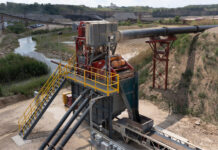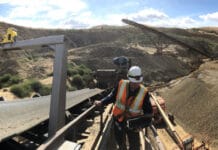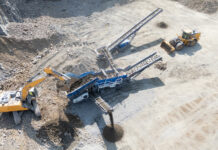
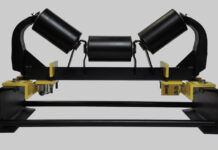
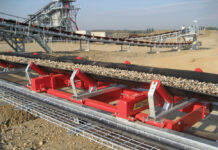
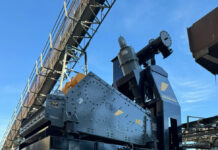
The purpose of this article is to provide you the reader with knowledge of how to select the proper installation location for a Conveyor Belt Scale. This is the first article in a three part series. Future issues will cover the topics of installation and continuing maintenance. A conveyor belt scale is a device which measures the rate at which material travels on a conveyor belt. It can also determine the total mass of material which has traveled over the belt during a given period of time. The conveyor belt scale provides a “weight-in-motion” unlike the static weight produced by a bench or truck scale.  | Complete Scale Installed. |
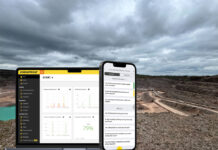
The conveyor belt scale uses an Integrator to monitor the static weight signal from load cells attached to a scale idler and integrates this weight with the speed at which the conveyor belt is traveling. Therefore, a rate of mass per time is produced (unit of mass/unit of time). This rate is continually displayed on the Integrator in addition to output to other devices such as Chart Recorders, Ethernet Networks, PLC Systems, and Report Printers. Many factors should be considered when selecting a location to install the belt scale. The following briefly describes certain locations which the most suitable for proper belt scale performance. Naturally, it is not possible to achieve all of the outlined criteria for every belt scale installation. However, each criterion should be observed if it is feasible. The conveyor belt scale should be installed in an area where the belt tension is constant. The tension of the belt is force acting on the scale and therefore is factored out during calibration. If the tension dramatically changes very often, then it is no longer a constant of the calibration. It is preferred that the conveyor system have some type of take-up device. A gravity take-up is best design. When possible, the scale should not be installed near the loading point of the conveyor. The loading of the belt usually varies in this location. This is also true near the head pulley or tail pulley of the conveyor. The scale should be installed at least five conveyor idlers from any of these locations. A conveyor belt that has an extreme angle of incline is not a suitable location for the scale. In these cases the material slides back down the conveyor thus causing the material to be weighed multiple times. Extreme inclines also increase angular forces on the scale. Conveyors with adjustable angles of incline are not proper locations for a scale. Locations where the conveyor forms a concave or convex curve should also be avoided. The scale should be located at least twenty feet (approx. six meters) from the apex of the curve. Other factors such as weather, vibration, or deflection of the conveyor can sometimes affect the scale. Many times these factors are unable to be controlled, but they should be avoided when possible. Future issues of this magazine will cover the topics of installation and continuing maintenance of conveyor belt scales. In closing while the best installation location could be determined using the information presented above; it is better to contact a manufacture with your specific specifications for their expert recommendation.
ConveyWeigh is a manufacturer of conveyor belt scale systems. The term "single idler" means that the scale utilizes one conveyor idler to weigh the material traveling on the belt. Naturally, the more idlers a scale uses for the weighing, the greater the total weigh area of the scale. Therefore, a four idler scale system will achieve a greater accuracy level than a scale system with only one idler. ConveyWeigh achieves this higher level of accuracy by using a modular design that places multiple idler scale systems in line on the same conveyor. To comment on this story or for additional details click on the related button above
|