New dredge, processing plant underscores Inland’s commitment to Winnipeg’s future

by Jon M. Casey

With the Grand Opening celebration of Inland Aggregates Limited’s Pine Ridge Aggregate operation near Winnipeg, Inland’s senior staff and management team welcomed the opportunity to introduce the Winnipeg metropolitan area to the most modern dredging operation and aggregate processing plant in Canada.

The Pine Ridge dredging operation produces quality sand to supply the central Canadian market.

The unveiling of Inland’s $27 million investment in the Rural Municipality (RM) of Springfield also set the stage for a source of quality aggregate materials for area customers that is expected to last for more than 30 years. From the time the greenfield site development began in the Pine Ridge area, Inland’s commitment to Winnipeg’s infrastructure redevelopment and booming construction market became evident.

“We take our commitment to the community seriously,” said Mike Smith, regional manager, Manitoba. “This plant replaces our CN pit operations, which will be retired at the end of 2008. Our permit is for 40 million (metric) ton of high quality granular concrete aggregates and sand. With that, we are looking to add to our product line, which will include asphalt fines and other value-added fine sand products. We know that the Birds Hill deposit here at Pine Ridge is an excellent resource for high quality aggregate.”


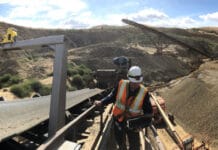
Plant operator Allen Baxter is comfortable in his new surroundings.

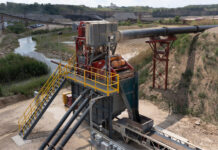
The dredge’s 16-yard bucket is filled with material that is ready to begin processing on the dredge. The dredge’s two-way rake grizzly and jaw crusher can be seen on the right.

New Rohr Dredge
Smith said the heart of the new Pine Ridge operation is a Rohr 16-yard clamshell bucket dredge outfitted with an onboard jaw crusher and fines recovery system that minimizes the loss of fines during the extraction process.

“The new dredge can extract material from the pit at the rate of 900 ton per hour at a depth of 60 feet,” said Smith. “The dredge was commissioned in August 2007 and came online in advance of the new Astec/KPI processing plant, which went into service in August 2008.

“We decided to go with a custom designed version of Rohr’s GT-1000 Gantry Dredge,” he continued. “We outfitted it with the onboard jaw crusher and a two way rake grizzly for the removal of oversized material and clay. It has the 6-foot x 20-foot double deck high frequency dewatering screens and a fine sand recovery system, which includes a high frequency fine sand dewatering screen, a vertical pump and cyclone. The entire unit is monitored by Rohr’s Bucket Monitoring and Diagnostics System.”

Smith said they especially like Rohr’s Bucket Monitoring and Diagnostics System because it gives them an exact picture of what is going on with the dredge at any given time.

“The dredge operator is able to watch his computer monitor, which gives him a visual display of what is going on with the bucket and support system,” said Smith. “If there is any malfunction, the system detects it and attempts to automatically make corrections to resolve the issue. If conditions exceed the system’s preset safeguards, the monitor prevents the equipment from damage. Some of the parameters that the diagnostic system monitors include the position of the bucket, the bucket head oil level, the oil temperature, the condition of its oil filter, the opening and closing pressure on the hydraulic cylinders and the tilting angle of the bucket.”


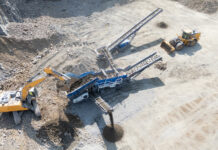
In the distance, one of the radial stackers can be seen stockpiling material as the Pine Ridge Aggregates plant produces material.

The dredge’s 16-yard bucket is filled with material that is ready to begin processing on the dredge.

Astec/KPI Processing Plant
From the dredge, the material is conveyed to a new $22.8 million Astec/KPI processing facility, which includes a prescreening plant and an aggregate processing plant. The prescreening plant splits the material into coarse and fine material, which is stockpiled with separate stackers over a cast in place concrete surge tunnel to feed the plant. The feed material is then drawn from the surge pile through gates with automated variable speed conveyors to the processing plant feed conveyor.

“The variable speed feeders allow us to fine tune and balance the coarse and fine feed going into the plant to maximize the plant efficiency and balance the quantity of finished stone and sand products,” said Smith.

Company officials from Lehigh Inland, Region Canada gather for a photograph at the grand opening of the Inland Pine Ridge site. From the left: Stan Sundquist, VP and GM Aggregates; James Kaskiw, Project Manager; Mike Smith, Regional Manager Manitoba; Shawn McMillan, VP Cement Sales/Logistics; and Jim Derkatch, president.

From the surge tunnel, feed material moves via conveyor to a plant that includes twin processing lines. Each side of the plant includes an 8- x 20-foot primary screen, a 4- x 30-foot log washer and an 8- x 20-foot gravel finishing screen.

From the primary screen, the fine sand material is split off to twin 12- x 48-foot classifying tanks before dewatering. The more efficient dewatering and fines recovery technology provides improved fine sand production, something Inland was unable to produce at their previous location. After the plant processes the finished products, electrically powered radial stackers stockpile them eliminating the need for loader stockpiling.

“The plant is capable of handling 1,100 (metric) tons per hour. This gives us additional capacity to meet current and future growth in market demand in our coarse and fine aggregate production,” said Smith. “With this new plant, we are able to consolidate all of these functions into one location, eliminating the need for material processing at other locations or by subcontractors. With our improved efficiency, we reduce costs and save on fossil fuels that might be used to transport or rehandle material for further processing.”


Auto-Ticketing, Central Dispatch
“Because we designed the new operation as a complete package, or what we like to call it, our ‘one touch production process,’ we were able to include several features into the design to make it highly efficient and environmentally friendly at the same time,” said Smith. “The new plant is fully automated, which means that from the moment material is extracted from the pit by the dredge to finished products, the crushing, washing, screening and stockpiling is all done with computer controlled technology. The ‘one touch process’ eliminates the need for loaders to feed or to rehandle material into the system as we once did.”


With the new centralized scaling and ticketing system, Smith said they are able to operate three loading sites while having the orders directed to one location for dispatching efficiency. “With these unmanned ticketing scales, our central dispatching staff is able to monitor activities and scale indicators remotely,” he said. “They are able to see trucks entering and exiting the pit as well as loading and scaling with video cameras. An RFID system automates the ticketing process, providing printed tickets from on-scale printers that reduce ticket retrieval times. More importantly, this system speeds up our truck loading times and gives us the tools that we need to track trucks more efficiently.”


Because Pine Ridge is near the city of Winnipeg, the close proximity minimizes the travel time for material transport. This reduces vehicle emissions and lowers the hauler’s fossil fuel consumption, Smith added. “Since haulers can get in and out of the plant quickly and efficiently, and because their hauling distances are reduced as compared to other aggregate producer locations, we are pleased that the environmental impact in this way will be greatly reduced,” he said. “We are pleased to meet or exceed Provincial environmental standards within the plant, and we like to think that this is one more way that we can be good stewards of our environment.”

Planning Benefits Everyone
As the Pine Ridge Aggregate Operation continues to come up to full production, Smith said he is excited both about the facility’s future and its benefit to the greater Winnipeg area. “The planning that went into this new operation is just one of the ways that Inland is supporting Winnipeg’s economic growth,” said Smith. “This new plant will offer a broader line of high quality, finished aggregate products that will aid Winnipeg’s building materials market. We continue to be a reliable resource of consistent quality materials because of the technology and attention to detail that went into designing and creating this world class facility.”

According to Smith, the Pine Ridge Aggregate operation enjoys an ongoing relationship with RM Springfield and Winnipeg. “We support several of the local charities through Inland’s Community Investment Program,” he concluded. “Because we are the largest producer of granular concrete aggregate in the Winnipeg area, the community looks to us as an industry leader.”

To comment on this story or for additional details click on the related button above.


^^TOP^^