Mining the benefits of PLC controls and innovative hydraulic systems in modern crusher design by Carol Wasson There was little change in basic crusher design during the latter half of the 20th century, other than that of improvements in speed and chamber design. However a significant growth spurt occurred in recent years with the development of hydraulic adjust, relief and clearing systems. Currently, the latter, combined with the latest in PLC control systems, marks a major milestone in modern crusher design. Producers tout the fast, easy setting adjustments; protection from component damage; ease of maintenance and the convenience of system monitoring and operational data delivery. These lead to labor and time savings; improved product quality and specification accuracy and lower costs per ton.
 | Crusher adjustments, troubleshooting and plant monitoring are a few of the functions performed by computers and hydraulic systems. |
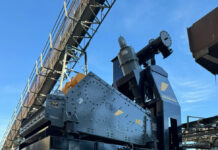
|  | Perkins Cinder has realized considerable cost efficiencies with the installation of a Telsmith 44SBS cone combined with TRAC10, a standalone crusher control system. |
|
The contemporary cone Perkins Cinder, in Arizona, has realized considerable cost efficiencies with the installation of a Telsmith 44SBS cone combined with TRAC10, a stand alone crusher control system. The cone’s hydraulics include a Dynamic Adjust system that enables adjustment under load; a hydraulic relief and clearing system for optimal overload protection; a hydraulic lock system that maintains minimum pressure under load; and an optional anti-spin system that extends manganese life and promotes a more cubical product. Their abrasive, yet fairly friable material is an application that requires frequent crusher adjustments and a need to accurately track liner wear. Although an “onboard computer” was at first met with some hesitation, the Perkins Cinder crew soon came to see it as valuable helping hand, with the biggest gain being the elimination of previously incurred downtime hours owing to manual crusher adjustments. At 500-tons per hour, that would add up to big bucks quickly. Now, with the push of a button, the operator can make adjustments several times a day while the crusher is running. In the past they would often avoid adjusting crusher settings just so they could keep running, which meant that it would take longer to crush material down to the desired specification. The operation’s plant foreman says that the elimination of “maintenance guesswork” is another big benefit. The TRAC10 will accurately indicate how much life is left in the liners. Also, the operator can easily monitor uptime hours and startup and shutdown times, which is valuable in determining scheduled maintenance. Previously, hours were read off of the generator, and since it would run longer than the crusher, the crew was often changing oil long before they needed to.  | Telsmith CrusherEarth2: For Earth Inc. the hydraulics on the 3258 jaw allow for fast, safe toggle adjustments, which can be achieved remotely directly from the cab of the excavator. |
|  | The Telsmith TI6060 track mobile crusher has hydraulic drive, allowing variable speed drive, overload monitoring by the PLC and efficient use of horsepower. |
|
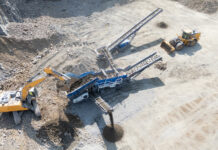
Essentially, said the foreman, the hydraulic systems and the automation package “makes the cone bullet proof.” If there is a major problem, the system will shut itself down to prevent damage to the crusher. Or, if they are running a lot of clay, the crusher will automatically open itself up to release pressure. In the end, he said, “this means less day to day job pressure and more consistent production.” The modern jaw Earth Inc. is a concrete recycler in the Chicago area. The owner chose a Telsmith track mounted Quarry-Trax crusher for its flexibility and for its 3258 jaw, which he said handles all the heavy work via its hydraulic systems, while keeping personnel out of harm’s way. The hydraulic chamber clearing system on the 3258 jaw automatically opens the crusher to a safe position, allowing materials to pass, while its hydraulic relief protects parts and components against overload damage. Also, the Earth Inc. plant operator likes the fact that the hydraulics in this modern jaw design allow for fast, safe toggle adjustment. “The toggle adjustment is done with remote control. You don’t have to shut the whole operation down and have a man climb into the machine. The worker who is loading the plant can make the adjustments remotely right from the cab of his excavator. This is a major time and money saver and a big safety factor, too,” he said.  |
“The differentiator between the hydraulics on the 3258 jaw and that of others is an issue of ‘true relief,” said Brian Jaworski, Telsmith product engineer. “The system has to be sized properly for true relief. When we designed our machines, we needed to make sure we had sized the hydraulic valves large enough so the crusher would open as quickly as needed while running. Other systems may not be engineered with enough flow to open that quickly,” he said. “Next, we added the PLC control and the cylinder sensor to pinpoint the setting position and allow for a resetting of the preset position after relief. This is a big upgrade from an earlier design of this jaw. We took what we learned from the system design of the PA6060 and adapted that to the 3258 jaw,” he added. Automated control systems require a different skill set or level of expertise when troubleshooting. Processors, sensors, communication cables and software are often not the strength for the typical electrician. As such, it’s important to identify up front the availability of manufacturer service and support, as well as what training requirements are necessary for existing plant personnel.
To comment on this story or for additional details click on the related button above. |