The expression, “If at first you don’t succeed, try, try again,” is a tool that parents and educators use to teach their youngsters persistence in accomplishing a goal. While it is not always easy to persevere and come to a successful end, the truth of that adage became reality for Oldcastle Materials company, Shelly Materials, in 2008. That was when they finally regained production goals for their Lockbourne, Ohio dredging operation, after their recently acquired DSC Marlin Class dredge, encountered an unexpected, highly compacted geological formation, one that rendered the dredge far less efficient than originally designed.  | | Lyn Condict, DSC Sales Representative (left) and Shelly Materials Operations Manager Jerry Mock (right) worked closely with DSC owners Bill and Bob Wetta to improve the performance of the Marlin Class Dredge (shown behind them) when difficult geology slowed the progress of Shelly Materials, Lockbourne, Ohio mining operations. |
“We were taken completely by surprise when deposits of compacted aggregate and clay formations cut our production capabilities by three-fourths,” said Jerry Mock, Operations Manager for The Shelly Company. “We had been producing 800 tons per hour with our new Dredging Supply Company Marlin Class dredge. When we hit the stiff clay and compacted aggregates, production dropped to around 250 tons per hour.” Lockbourne’s history Mock recalls that the Lockbourne operation began in the 1960s and over time, the site changed ownership more than once. During that time, there was no continuing mine plan in place, so as a result, considerable reserves were lost in the process. When Shelly Materials acquired the operation in 2002, they were committed to bringing operations up to today’s production standards by implementing the latest technology as a way of enhancing their investment. “The previous owners mined the Lockbourne site with a dragline,” said Mock. “That system was unreliable, with limited production capabilities. When Shelly began mining here, a large percentage of the pit had been mined with the existing equipment. So we were determined to continue working this site with equipment that would help reach the maximum potential of the deposits that remained yet unmined.” DSC’s Marlin-class dredge was the right choice for the Shelly Materials Lockbourne, Ohio plant. |
| Early results with this cutting head uncovered extremely dense geological formations. |
|
New mining objectives “As we began to look for other ways to extract the remaining aggregate, we found that we were somewhat at a disadvantage because of insufficient data,” he continued. “We knew that the deposit extended well beyond the current 40-foot depth that had been mined. We had few boring samples from previous samplings, and we knew that additional borings were not economical or feasible. More importantly, we were aware that deeper mining was possible because we knew from neighboring mines that the material was there. We believed that the deeper the mine, the finer the deposit.” “So it was with that thinking in mind that we were looking for a dredge that could mine in excess of 100-feet and produce tonnages of 800 tons per hour or greater,” he said. “We wanted to capture a particle size no greater than 9 inches, and we were willing to modify the existing de-watering system to accommodate this kind of production rate. We looked into Bucket Ladder systems, Clamshell dredges and a larger dragline excavator as ways to continue mining the site successfully, but we finally determined that a Marlin Class, DSC dredge was the best choice for this application.” Mock said that DSC recommended a modification to the standard cutter system that came on the Marlin Class dredge. They determined that a screening device be added to the cutter so that rocks larger than 9 inches would be prevented from entering the dredge’s suction system, thereby preventing unwanted clogging and problems at the de-watering wheel. “So, we went with an electric-powered dredge because of the lower maintenance costs and the higher percentage of dredge availability,” said Mock. “We were also looking at protecting the environment not only on site, but by reducing the need for fossil fuels to power the equipment. We could see that the energy savings would lower operating costs, and we wanted to do that as well.” DSC worked with Shelly people, trying various drill head designs in an attempt to improve mining capabilities, to no avail. |
| The ultimate solution to the compacted clay and aggregate geology was a high-pressure water jet system with nozzles located at strategic points as what Jerry Mock calls, “a way to shred and dissolve the hard clay into something more manageable for the cutter.” |
|
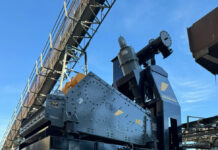
Armed with these considerations, Lyn Condict, Domestic Sales Representative for DSC, worked with Mock and his design team, to recommend a 18” x 16” Electric Marlin Class Underwater Pump Dredge, capable of digging to a depth of 100-feet. Together, they were looking for an 80-percent operating efficiency when working in material that was described as “well-graded fine gravel.” The Marlin had an inside suction diameter of 17.25 inches, with an inside discharge diameter of 15.25 inches. The Marlin had a terminal elevation of 40 feet with a maximum discharge length of 1500 feet. This seemed like the ideal solution. And it was. That is, until the mining crew experienced what Mock called “a significant change in the deposit!” “The DSC unit worked extremely well until we came upon a layer of compacted aggregate, just beneath the fine sand,” he said. “There was also a thick lens of clay that we found to be 15 feet thick in some places. Our production rate tumbled, the more we had to deal with those compacted aggregates and that stiff clay. The well-graded fine gravel had disappeared and our production rate dropped to as low as 200-300 tons per hour.” Mock said that they were finding that the dredge’s ladder was experiencing serious additional stress because of the new deposit. “After digging through a thick lens, the clay would collapse onto the dredge ladder,” he said. “We knew that this kind of action would jeopardize the ladder’s integrity. We tried several new cutting edges to see if we could improve production. None worked. So, we went back to the drawing board!” Shelly’s DSC 18x16 Electric Marlin-class dredge is quietly busy, mining material from the floor of Lockbourne’s pit. |
| Material is pumped from the dredge to this dewatering wheel before being stockpiled. |
|
Trying again Mock said that DSC proposed the addition of two, underwater, high-pressure water jets designed to shred and dissolve the hard clay as the cutter was doing its work. “They installed one jet at a 45-degree angle above the cutter head, and one jet directly above the cutter on the starboard side, that would break down the compacted aggregate and hard clay simultaneously, in hopes of improving the cutter’s mining capabilities,” he said. “It worked very well.”
“Before we added the water jets, we were producing between 200 and 300 tons per hour,” said Mock. “Our production rose to 500 to 600 tons per hour after the jets were in operation. Not only that, we found that when the dredge would hit areas of good quality material, production rates would increase significantly - to as much as 1100 tons per hour.” Mock said that he enjoys the way that DSC stuck with the problem and came up with a workable solution, one that exceeded their expectations. “We were extremely frustrated when we weren’t able to improve the problem with a new cutter head,” he said. “But once the water jets were installed, we saw a dramatic improvement. We are grateful to the DSC engineers who found a way to deal with this troubling problem.” To comment on this story or for additional details click on the related button above. |