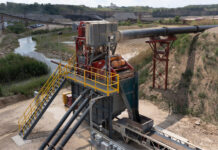
In Prasville near Chartres / France, the company SMBP brought into use a novel HAZEMAG roller grating, the VARIOwobbler®.  First HAZEMAG VARIOwobbler® in France
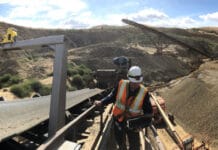
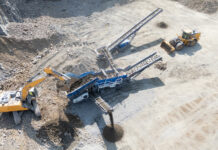
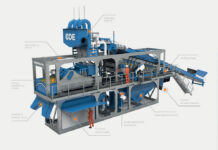
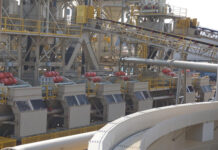
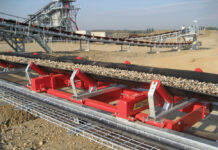
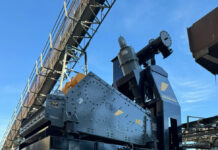
| This has the special feature that it can change the grain size of the screening on the third stage, where the separation distance between the shafts is adjusted hydraulically. As a result of this first-time employment of the machine in France, the operator achieves both a significantly-improved, constant product quality despite changing climatic conditions over the entire year, and a considerable increase in the performance of his conditioning plant. Production is now 7000 t per day, instead of 5000 t per day. It simultaneously reduces wear in the downstream impact crusher and uses water resources for the washing process sparingly. Depending on the season, the quarry of the operator supplies rock with widely varying qualities: dry in the summer and very moist and sticky in winter. Both pre-comminuted material with a granulation of 0 - 300 mm, as well as non-comminuted material with a granulation of 0 - 2000 mm, are provided to the existing crushing plant. A high clay loam content of 10 - 12%, with peaks up to 40% with a high level of clay-content fines, has resulted, particularly in the winter, in considerable problems with the vibration screen employed to date for the preliminary screening. Again and again severe clogging resulted, which could be removed only with a mini-excavator. This resulted both in a contamination of the finished product and a considerable reduction of the system performance to 300 t/h. This was not acceptable for the operator of the system, Christian Laye. So he decided to employ the novel VARIOwobbler® roller grating instead of the existing vibration screen. This could be fitted exactly into the existing system, between the loading steel-plate conveyor and the existing impact crusher. It was fitted with 3 stages in order to bridge the height. However, this also offers the additional advantage that the material itself is rolled over at the stages, as a result of which the screening result improves. In the case of roller gratings, the filter surface consists of several rotating shafts between whose open spaces the finely-ground product falls. Disks are attached on the shafts according to the separating grain size. The shape of the disks in 3-bend type supports the conveyance of the material. Furthermore, the VARIOwobbler® offers the possibility to adjust the separation distances between the shafts within a pre-determined range, at the push of a button with an hydraulic-mechanical system. At SMBP this is possible in the third section. While in the two first stages, the separation distance is fixed constantly at 80 mm, it can be adjusted in the third stage from 80 mm to a maximum of 120 mm.  Feeding limestone with sticky clay
| |  Clean limestone after two screening steps
| | The objective of the screening process is the avoidance of adhering loam and clay contents, in order to achieve an acceptable degree of contamination, while also achieving consistent product quality, trouble-free operation and reduced wear in the impact crusher. In the summer, when the material is clean and dry, the Vario range is therefore also operated with a separation distance of 80 mm. It is necessary to send only a small amount of material to the washing system, and this saves considerable quantities of water. In the winter, the material is wet and sticky, with considerable adhering contamination. Under these conditions, the separation distance is adjusted on the third stage to 100 mm, or, if necessary, even to 120 mm. Now of course more material must be sent to the washing system. However it is still less than was formerly necessary with the vibration filter, which had a mesh width of 150 mm. It is also beyond comparison with the former product quality, since in case of frequent unclogging of the screen with the mini-excavator, everything was conveyed into the crusher (including loam and clay). And the VARIOwobbler® does not clog up! The operational startup in winter put it to the test under the most severe conditions. In addition to the usual unfavorable conditions during this period it had snowed, so that the material conveyed, which had already been stored for a significant time in the bunker, was especially sticky. The owner Christian Laye was very anxious to see how the special roller grating would function. The ensuing trouble-free operation indicated to him that he had made the correct decision. The system performance is now 600 - 800 t/h. This alongside the improvements already described above means the investment has rapidly amortized. For more information about Hazemag visit the WEBSITE button above, click on the REQUEST MORE INFO button above, or click on the DIRECT CONTACT button to reach Hazemag directly. |