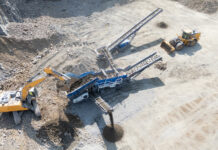
The processing of construction and demolition waste and the production of secondary aggregates places very specific demands upon crushing and screening equipment. So when Sandvik Mobile Crushing and Screening (formerly Extec and Fintec) set about upgrading its market leading C-10 and C-12 track mounted mobile crushers to the QJ240 (Extec C10+) and QJ340 (Extec C-12+) specifications, maneuverability, productivity and reliability were top of the design agenda. The QJ340 Track Mounted Mobile Crusher. |
There really is no such thing as an easy crushing or screening application; the constant grinding of stone on metal will ultimately take its toll, regardless of just how abrasive the material is. But few applications are as tough and demanding as recycling and the production of secondary aggregates. Track mounted mobile screens and crushers working in this hostile environment rarely have the luxury of working on a flat, prepared surface and are required to track across highly abrasive rubble. The feed material can contain everything from steel reinforcing bar, with its ability to shred conveyors, to timber that can quickly block a crusher’s jaw. In addition, machines working in this application often do so in an inner city environment where space is at a premium. Such equipment must, therefore, be compact and highly maneuverable as well as tough and durable. When the design engineers set about upgrading its market-leading C-10 and C-12 crushers to the QJ240 and QJ340 specifications, they were mindful of all these specific demands. And the result is a pair of track-mounted crushers that are the most application specific on the market. Tougher and More Durable Both new machines are carried on a sturdy, angled superstructure that is significantly heavier than that of its predecessor, providing a significantly more stable crushing base. To cope with the ever-present danger of blockages and bridging, the jaws on both machines are quickly and easily operated in reverse to free any blockages that might occur. They also feature a “fast track” system to help free tangled steel reinforcing bar, a common cause of crusher downtime in recycling applications. As the manufacturing consultant on the National Federation of Demolition Contractors’ guidance notes on the safe use of mobile crushers in a demolition environment, Sandvik is also mindful of the need to isolate and protect the operator. Both the QJ240 and QJ340 are, therefore, offered with a dual operating system that helps overcome concerns of exposure to whole body vibration. In standard configuration, the machines are operated from an easily accessible control panel located safely within reach of an operator stood beside the unit. From here, the machine’s engine, hydraulics, feeder, crusher and conveyors can be controlled. A separate “umbilical” control offers some limited stop/start and travel controls and is, perhaps, better for maneuvering the machine across site. As an option, Sandvik offers a further remote control option that allows the unit to be stopped and started by the operator of the machine responsible for feeding it.
In response to feedback from customers, the QJ240 and QJ340 have also been designed for ease of maintenance. Both units are supplied with SKF sealed-for-life bearings as standard together with an automatic jaw lubrication system. Below the jaw discharge point, Sandvik’s designers have allowed a large gap to prevent material blocking between jaw and conveyor and to facilitate cleaning. More impressive is the machine’s ability to raise itself vertically on four hydraulically actuated support legs. Traditionally used to provide a flat, event operating base, this capability also works as an effective “jack,” allowing tracks to be maintained, removed and replaced with ease. SMR Production But this work, the result of a significant investment in research and development and years of customer research and feedback, has not been in vain. Indeed, the new “plus” versions of these two market leading mobile crushers have been universally accepted by customers across the world; and the new units are building upon the C-10 and C-12 legacy. One company that is harnessing the QJ240 capabilities is Sustainable Aggregates, one of the companies pioneering the use of Structural Material for Reinstatement (SMR). Operating from a 1.2 hectare recycling facility at Copthorne in Sussex, close to Gatwick Airport, the company is using a QJ240 together with a QE340 (E-7 Screen) to produce a high strength reinstatement material. Fed by a Komatsu 210LC hydraulic excavator, the QJ240 easily copes with the 10 -14 daily loads of utility waste, reducing it to the required 50 - 60 mm grade. The unit’s grizzly bars remove the majority of the fines while oversized material is removed through a side conveyor for recrushing. “The two Sandvik machines make light work of the material to be processed. They have more than proved their productivity,” says managing director Clive Holloway. “At present, we are processing about 1,000-tonnes of SMR each week but we hope to produce 4,000-tonnes per week in the near future. And the Sandvik machines are more than capable of achieving those levels of throughput.” Holloway believes that productive, reliable and mobile machines are the key to a successful, national network of local SMR production facilities. “The idea behind these small local sites is to process locally, providing a product customized for individual clients, but without the vehicle movements required to move the product from large national depots. We already have top quality BSEN specifications and have applied for our CE mark. In my opinion, SMR products are the best way to reclaim and recover 100 percent of C&D waste. This is compared with the 40 to 60 percent achieved by conventional methods,” Clive Holloway concludes. “The savings are enormous for the customer and they are an obvious way of avoiding landfill taxes and reducing their carbon footprint. Once the sites are running to speed they should produce a product that is cost neutral and the productivity of the two Sandvik machines will help achieve that.” Waste Into Profit Another company utilizing Sandvik technology to convert a waste stream into a revenue stream is West Yorkshire-based Dennis Gillson & Sons Ltd which is using a QJ340 mobile jaw crusher and a QH340 (X38SBS) mobile cone to create a high quality aggregate from the waste from the decorative stone production process. The 70 year old company quarries the 7.0 hectare Naylor Hill Quarry to produce decorative sandstone, for flagstones and architectural finishing features such as lintels, sawn heads, sills, jambs, steps and copings and edging plus finished complicated masoned material, such as quoins, sawn pavings and fire places. The QJ340 is fed by a Cat 365BL hydraulic excavator in mass excavation configuration. The crusher is fitted with grizzlies that remove the fines prior to crushing to help maintain the quality and consistency of the end product. With its jaws set t to >90 mm, the QJ340 feeds directly into the QH340 cone which in turn produces a 38 mm primary aggregate product. The output from the track-mounted mobile Sandvik cone is also screened to produce a wide variety of other fractions 10, 6 and 4 mm together with a sand product. Gillson says that the combination of Sandvik machines will easily produce more than 200-tonnes per hour but says that he is more interested in quality than quantity. “We pride ourselves on the quality of our finished stone products so we have traditionally seen the overburden purely as a waste,” he concludes. “But with the purchase of the Sandvik machines, we are now using that same material, together with the waste from the finishing processes, to produce a valuable commodity.” Designed for Demolition A QJ340 is also helping London-based Gregory Demolition to convert its steady stream of construction and demolition waste into a valuable commodity. Indeed, in one recent flurry of activity, the company processed 10,000-tonnes of C&D waste in just three days using the 49-tonne machine. The material, arising from the demolition of three double tunnels and a 3,000 m2 bridge structure over the Liverpool Street railway line near London’s Brick Lane, was transported to Gregory’s Barking recycling facility for processing by the newly purchased QJ340. Managing director Dean Gregory reports that material is crushed to order and that productivity is not a major issue in this application. That said, Gregory says that he has been impressed by sheer speed of the Sandvik machine. “The QJ340 is much faster than our previous machines. In fact, our loading excavators have trouble keeping pace with it,” concludes managing director Dean Gregory. “Sandvik crushers are reliable and are ideal for demolition work. They’re rugged, well built and, best of all, they are not over complicated. This makes them easy to work with and easy to train our staff to operate them.” To comment on this story or for additional details click on the related button above.
|